Booking choice: The full day from Izmir, from $129 per person. Check dates Tour details
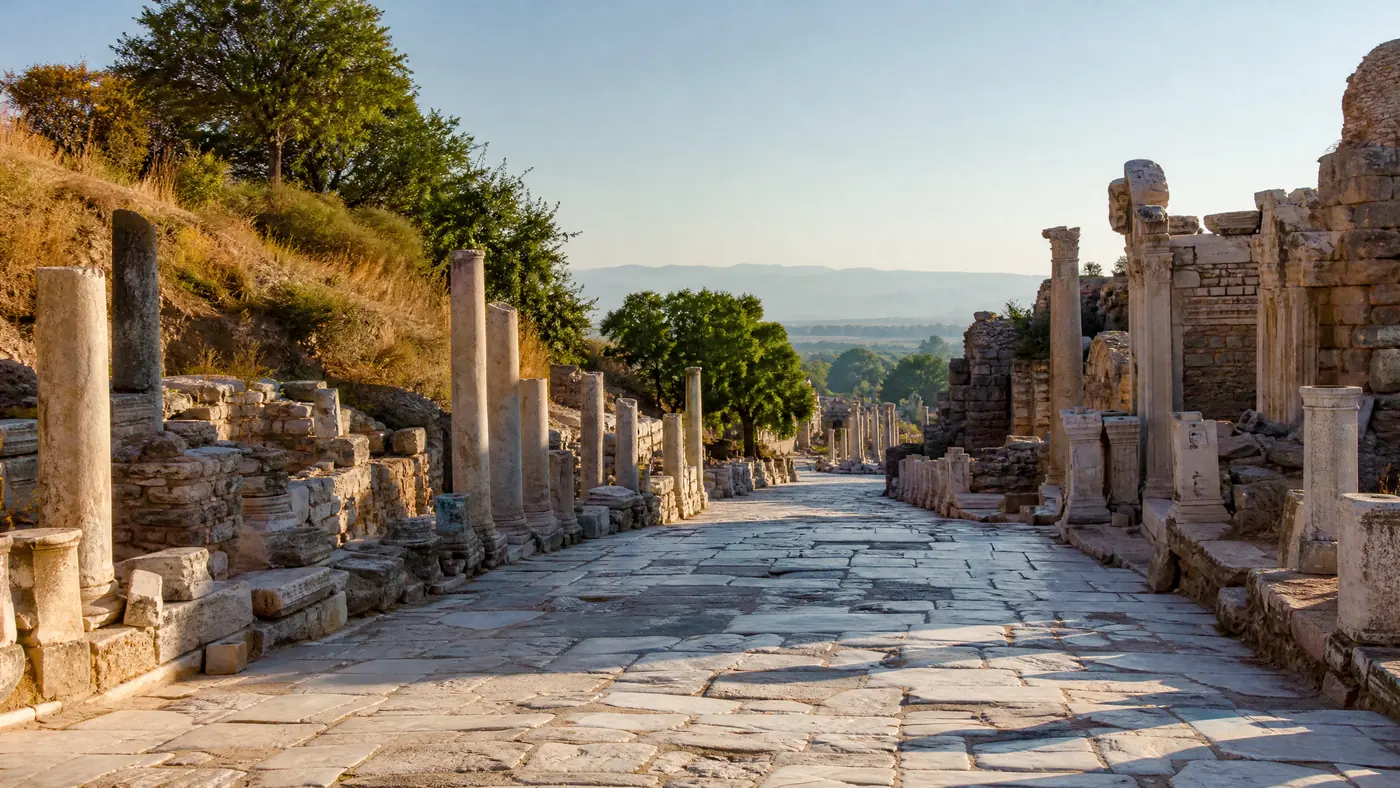
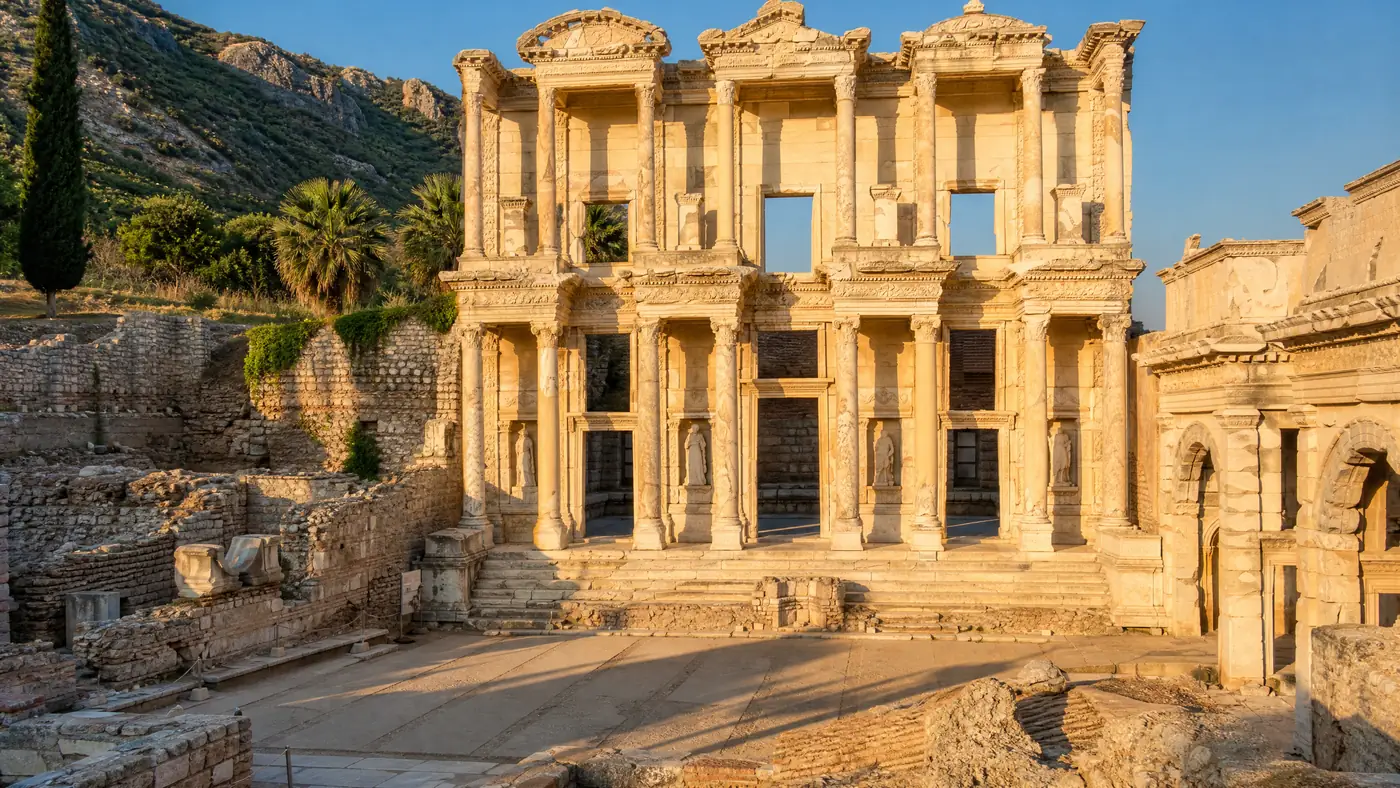
Short answer: yes. Ephesus is a UNESCO World Heritage Site, the capital of a Roman province, a city of Paul and John in the Christian story, and the home of one of the Seven Wonders. You walk down a marble street to a two-story library facade and a theatre built into the hill.
Below: why Ephesus is famous, what a visit covers, the connection to St Paul and St John, what is left of the Temple of Artemis, why the city was abandoned, whether it is Greek or Turkish, and a table of what each tour adds to the day.
The quick answer
Yes. Ephesus is a UNESCO World Heritage Site since 2015 and, in UNESCO's words, an outstanding example of a Roman port city. You see the Library of Celsus, the great theatre, Curetes Street and, with a second ticket, the Terrace Houses. The 40 euro ticket includes the Ephesus Experience Museum. Go with a guide on a first visit.
Is Ephesus worth visiting?
Yes. Few ancient cities let you walk a whole Roman street plan from end to end, past a library facade and a theatre that still stand to their full height.
UNESCO inscribed Ephesus on the World Heritage List in 2015. Its description sums the place up: successive Hellenistic and Roman settlements that followed the coastline as it retreated west, grand Roman monuments such as the Library of Celsus and the Great Theatre, and an outstanding example of a Roman port city, with its sea channel and harbor basin.
What that means on the ground:
- A whole city, not a single monument. Streets, squares, fountains, temples, public latrines, shops and houses, in one walk.
- An easy route. Start at the upper gate and the walk runs downhill to the library and the theatre.
- A lot around it. The Temple of Artemis, the Basilica of St John and the House of the Virgin Mary are all near Selcuk.
Who might feel differently? Someone expecting a museum with labels on everything. Ephesus is open ruins that tell you little on their own, which is exactly why a guide makes such a difference.
Why is Ephesus so famous?
It was one of the great cities of the Roman East: the capital of the province of Asia, a major harbor, and home to the Temple of Artemis, the Library of Celsus and the great theatre.
UNESCO records that when Asia Minor became part of the Roman Empire in 133 BCE, Ephesus was made capital of the new province of Asia. The ministry describes a key player in East-West trade, with one of the most important harbors in the Mediterranean, and a long run of peace and prosperity from the reforms of Augustus to the third century AD.
The buildings you see today come mostly from that time:
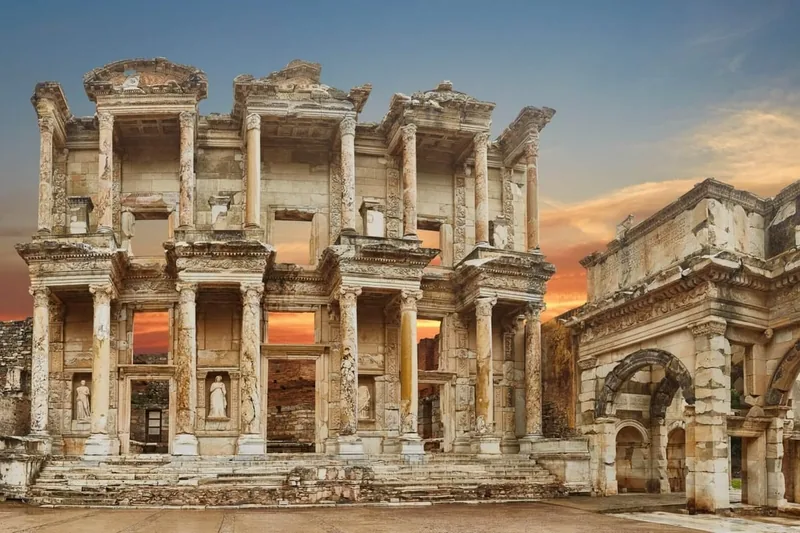
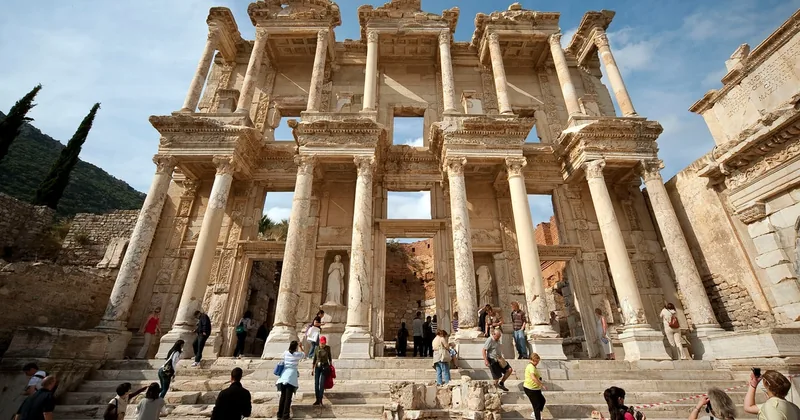
- The Library of Celsus. Built about 125 AD in memory of Tiberius Julius Celsus Polemaeanus, a governor of Roman Asia, who lies in a sarcophagus beneath it. Wikipedia says it held nearly 12,000 scrolls; the facade was reconstructed between 1970 and 1978.
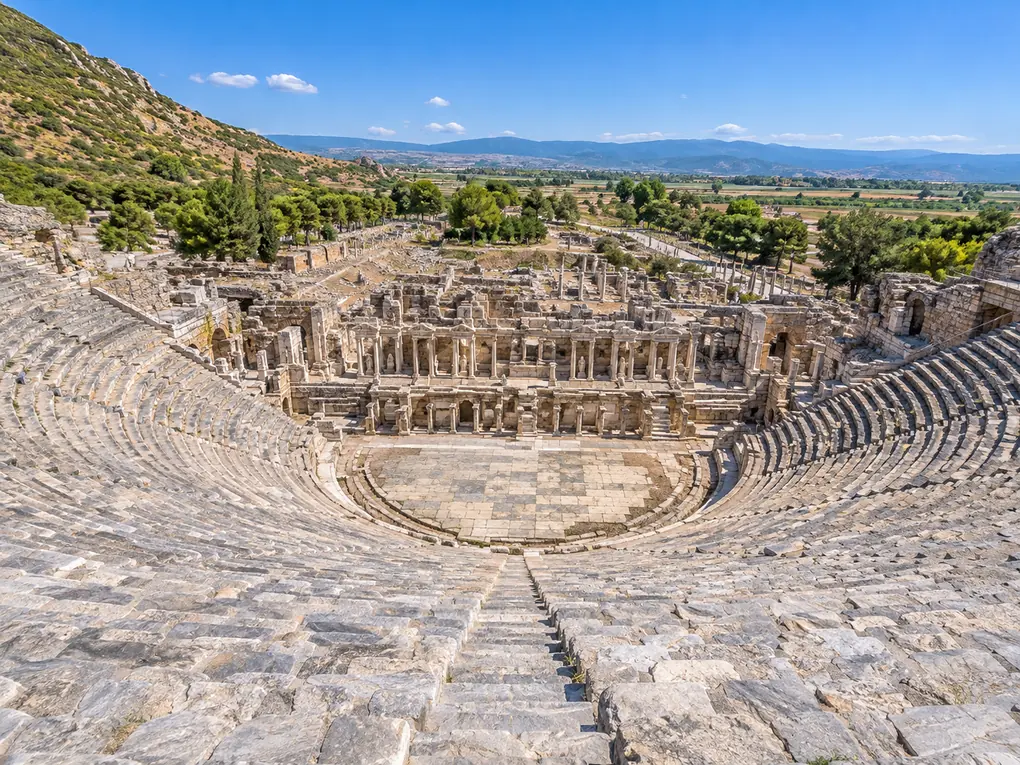
- The great theatre. Renovated during the Pax Romana, per the ministry. Wikipedia gives an estimated capacity of about 25,000.
- The agora. The business district, begun under Tiberius about 23 AD and surrounded by a two-story stoa, per the ministry.
Strabo, the Greek geographer, ranked Ephesus second only to Rome in importance, as Wikipedia quotes him.
What do you actually see on a visit to Ephesus?
A downhill walk from the Odeon and the State Agora along Curetes Street to the Library of Celsus, then the great theatre and the Harbor Street.
Most guided visits follow the same order, from the upper gate down. The all-inclusive day from Izmir lists it stop by stop:
- The Odeon and the State Agora, the city's council and civic heart.
- The Prytaneion, the Memmius Monument and the Temple of Domitian.
- The Hercules Gate, then Curetes Street, polished by two thousand years of feet.
- The Temple of Hadrian and the latrines, which always get a laugh.
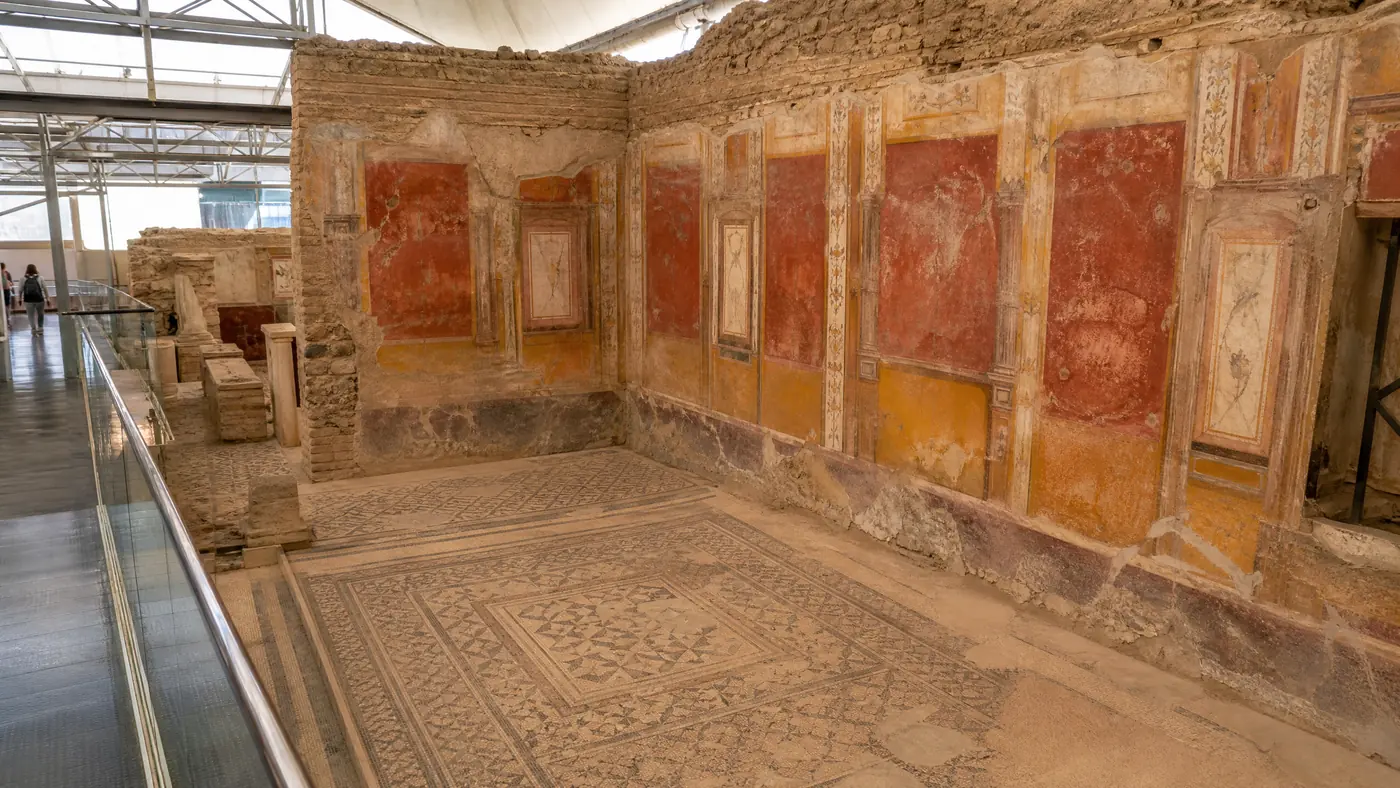
- The Terrace Houses, an option on a separate 15 euro ticket.
- The Library of Celsus, the Marble Road and the Commercial Agora.
- The great theatre and the Arcadian Way, the old road to the harbor.
The guided walk takes about two hours on most listings. Add the Ephesus Experience Museum, opposite the theatre and included in the 40 euro ticket, where the ministry says visitors meet figures from Androklos, the city's founder, to Cleopatra and St Paul.
The full day from Izmir then adds the House of the Virgin Mary, the Temple of Artemis and the village of Sirince, with lunch and the entry fees in the price, from $129 per person.
A full day from Izmir with the entry fees and lunch: the House of the Virgin Mary, Ephesus, the Temple of Artemis and Sirince.
Explore the full day from Izmir Tour detailsWhat is the connection between Ephesus, St Paul and St John?
St Paul lived and preached in Ephesus, per the Acts of the Apostles. St John is believed to have written his Gospel there, and tradition holds that he brought Mary with him.
The ministry says the city became a key place in the spread of Christianity, the base from which St Paul launched many of his missions. Wikipedia, drawing on the Acts of the Apostles, places Paul in Ephesus for about three years, from 52 to 54 AD: he preached first in the synagogue and then in the school of Tyrannus, until Demetrius the silversmith stirred up a crowd against him, fearing for the trade in silver shrines of Artemis.
St John is the other great name. The ministry describes him as believed to have written the Gospel of John in Ephesus, and the Basilica of St John in Selcuk stands on what is held to be his grave (tickets 6 euros, and the hours run 08:00 to 18:00).
Then there is Mary. Tradition holds that St John brought the Virgin Mary to Ephesus four or six years after the death of Jesus, as the ministry puts it. The house on Bulbul Dagi, 9 km from Selcuk according to the Selcuk municipality, was identified in 1891 by Lazarist priests following the visions of Anne Catherine Emmerich. Pope Paul VI visited in 1967, and a mass is held there every 15 August.
UNESCO adds two church councils held at Ephesus, in 431 and 449 CE. Ephesus is also one of the seven churches of Asia addressed in the Book of Revelation, as Wikipedia notes.
What is left of the Temple of Artemis?
One column. The temple was one of the Seven Wonders of the Ancient World; today a single column stands on its site near Selcuk.
Ephesus grew up around a shrine of Artemis, the ministry writes, and UNESCO dates the sanctuary of the Ephesian Artemis to the 2nd millennium BCE, originally an Anatolian mother goddess. It became one of the largest sanctuaries of the ancient world, and its temple one of the Seven Wonders.
Its story, per Wikipedia:
- About 550 BC, the great temple is completed.
- In 356 BC, a man named Herostratus burns it down. The Ephesians rebuild it, larger, and turn down Alexander the Great's offer to pay for it.
- In 263 AD, the Goths sack the city and the temple.
- Today, one column remains, uncovered by a British Museum excavation in the 19th century.
UNESCO's words are blunt: little remains. Go for the setting and the story rather than the ruin. Most full-day tours stop here for a short visit, and the easy shore excursion gives it 15 minutes.
Why was Ephesus abandoned?
Mostly because the harbor silted up. The river filled the bay with sediment, the coast moved west, and the city lost the sea that had made it rich.
UNESCO describes a shoreline that shifted continuously from east to west through sedimentation, which forced several moves of the city and its harbors. Wikipedia names the river, the Kucuk Menderes (the ancient Cayster), and says it slowly silted up the harbor despite repeated dredging, cutting the city off from the Aegean. The old harbor now lies about 5 km inland.
Other blows came on top:
- Marshes and malaria, left behind by the silt, per Wikipedia.
- The Goths in 263 AD.
- A destruction in 614, long put down to an earthquake; a 2022 excavation links it to war instead, Wikipedia notes.
- Arab raids in the 7th and 8th centuries.
Life moved to Ayasuluk Hill, where Selcuk stands today. The ministry says the people of Ephesus relocated there, around the Basilica of St John, and UNESCO points to the Mosque of Isa Bey and the medieval settlement on the hill as the mark of the Turks, first the Seljuks and then the Ottomans. Wikipedia says the old city was completely abandoned by the 15th century.
Is Ephesus Greek or Turkish?
Both, at different times. Ephesus was an ancient Greek city and then a Roman one; today its ruins are in Turkey, near Selcuk in Izmir province, and its Turkish name is Efes.
The ministry describes Ephesus as founded as an ancient Greek settlement on the Aegean and dates the Greek colonization of the area to about 700 BC. Wikipedia puts the first Attic and Ionian Greek colonists earlier, in the 10th century BC. Settlement in the area goes back much further, to about 6,000 BC, per the ministry.
The timeline after that, in brief:
- In the 4th century BCE, Lysimachos, one of Alexander's generals, founds the new city where the ruins stand today (UNESCO).
- In 133 BCE, Ephesus becomes capital of the Roman province of Asia (UNESCO).
- From the 5th century CE: pilgrimage to the Church of Mary and the Basilica of St John.
- The Seljuks and the Ottomans: the town on Ayasuluk Hill, today's Selcuk.
The site you visit is run by Turkey's Ministry of Culture and Tourism as the Ephesus Archaeological Site, Efes Oren Yeri in Turkish.
Which Ephesus tour makes the trip worth it for you?
The one that matches your starting point and time. Cruise passengers pick a half day from the port; from Izmir, a full day adds Mary's House, Artemis and Sirince.
Every tour covers the ancient city with a guide. The difference is where it starts, what the day adds and whether the 40 euro ticket is in the price:
| Tour | Starts from | Length | The day adds | 40 euro ticket | From |
|---|---|---|---|---|---|
| From Izmir: All-Inclusive Full-Day Ephesus Tour with Lunch | Hotel or cruise pickup, Izmir | 8 hours | Virgin Mary, Artemis, Sirince | Yes, entry fees in | $129 |
| Ephesus Small-Group Tour for Cruise Passengers | Kusadasi cruise port | 5 hours | House of the Virgin Mary, lunch | Yes, skip-the-line tickets | $29 |
| Ephesus & House of the Virgin Mary for Cruisers | Kusadasi cruise port | Set by your port time | House of the Virgin Mary | Confirmed on the listing | $26 |
| Easy Ephesus Shore Excursion | Kusadasi cruise port | 4 hours | The ancient city only, ticket extra | No, 40 euros extra | $20 |
| Ephesus & Terrace Houses Tour from Kusadasi Port | Kusadasi cruise pier | 5 hours | The Terrace Houses | No, entrance fees extra | $61 |
| Half-Day Ephesus & Sirince Village Tour | Kusadasi cruise port | 6 hours | Sirince village in the hills | Confirmed on the listing | $26 |
| Private or Group Ephesus & Virgin Mary Tour, No Hidden Fees | Kusadasi cruise terminal | 4.5 to 6 hours | Virgin Mary, Artemis, tickets in | Yes, skip-the-line tickets | $110 |
| Ephesus Full-Day Tour from Kusadasi or Selcuk | Hotel or cruise pickup, Kusadasi | 8 hours | A full day with lunch, fees in | Yes, entrance fees in | $105 |
| Budget-Friendly Ephesus Tour from Izmir | Meeting point in Konak, Izmir | 9 hours | Transfer and guide, tickets extra | No, extra | $44 |
| Ephesus Expert-Led Walking Tour from the Entrance | The Upper Gate of Ephesus | 2 hours | A historian guide, downhill route | Only if you pick that option | $109 |
| From Istanbul: Ephesus Day Trip with Flight and Lunch | Pickup in Istanbul | 13 to 16 hours | Flights from Istanbul | Confirmed on the listing | $308 |
From-prices are GetYourGuide's, in USD per person; every option cancels free up to 24 hours before. Coming by ship? Our cruise guide walks through the port day. Planning the ticket yourself? The ticket guide has every price and opening time.
The all-inclusive full day from Izmir: entry fees and lunch in the price, with Mary's House, Artemis and Sirince.
Check dates for the full day from IzmirFrequently asked questions
Did Jesus ever visit Ephesus?
The sources we use do not place Jesus in Ephesus. The city's Christian story is tied to St Paul, St John and the tradition that John brought Mary there.
Is the Virgin Mary buried in Ephesus?
It is a tradition, not a record. The ministry's page on the Basilica of St John says it is believed that John buried her somewhere on the mountain.
Which apostle is buried in Ephesus?
St John. The ministry says the Basilica of St John in Selcuk was built over his grave.
What does Efes mean?
Efes is simply the Turkish form of the name Ephesus. The site's official name is Efes Oren Yeri, the Ephesus Archaeological Site.
Ready to book
Choose your tour
Free cancellation up to 24 hours before on every option. Prices are from-prices in USD and move with the season.
From Izmir: All-Inclusive Full-Day Ephesus Tour with Lunch
- Hotel or cruise pickup and drop-off
- Air-conditioned vehicle and guide
- Entry fees
Ephesus Small-Group Tour for Cruise Passengers
- Pickup at the Kusadasi cruise port
- Small-group guided tour of Ephesus
- Skip-the-line tickets
Private or Group Ephesus & Virgin Mary Tour, No Hidden Fees
A private or group day with the tickets in the price